The author shows how the institutional dynamics of the last half-century have transformed the American presidency into a potential platform for political extremism and lawlessness. Watergate, Iran-Contra, and the War on Terror are only symptoms of deeper pathologies. Ackerman points to a series of developments that have previously been treated independently of one another—from the rise of presidential primaries, to the role of pollsters and media gurus, to the centralization of power in White House czars, to the politicization of the military, to the manipulation of constitutional doctrine to justify presidential power-grabs. He shows how these different transformations can interact to generate profound constitutional crises in the twenty-first century—and then proposes a series of reforms that will minimize, if not eliminate, the risks going forward.
The book aims to begin a new constitutional debate. Americans should not suppose that Barack Obama’s centrism and constitutionalism will typify the presidencies of the twenty-first century. We should seize the present opportunity to confront deeper institutional pathologies before it is too late.
Author: Peter Dauvergne The Shadows of Consumption gives a hard-hitting diagnosis: many of the earth's ecosystems and billions of its people are at risk from the consequences of rising consumption. Products ranging from cars to hamburgers offer conveniences and pleasures; but, as Peter Dauvergne makes clear, global political and economic processes displace the real costs of consumer goods into distant ecosystems, communities, and timelines, tipping into crisis people and places without the power to resist.
In The Shadows of Consumption, Peter Dauvergne maps the costs of consumption that remain hidden in the shadows cast by globalized corporations, trade, and finance. He traces the environmental consequences of five commodities: automobiles, gasoline, refrigerators, beef, and harp seals. In these fascinating histories we learn, for example, that American officials ignored warnings about the dangers of lead in gasoline in the 1920s; why China is now a leading producer of CFC-free refrigerators; and how activists were able to stop Canada's commercial seal hunt in the 1980s (but are unable to do so now).
Dauvergne's innovative analysis allows us to see why so many efforts to manage the global environment are failing even as environmentalism is slowly strengthening. He proposes a guiding principle of "balanced consumption" for both consumers and corporations. We know that we can make things better by driving a fuel-efficient car, eating locally grown food, and buying energy-efficient appliances; but these improvements are incremental, local, and insufficient. More crucial than our individual efforts to reuse and recycle will be reforms in the global political economy to reduce the inequalities of consumption and correct the imbalance between growing economies and environmental sustainability.
One of the most popular Fortune articles in many years was a cover story called “What It Takes to Be Great.” Geoff Colvin offered new evidence that top performers in any field--from Tiger Woods and Winston Churchill to Warren Buffett and Jack Welch--are not determined by their inborn talents. Greatness doesn’t come from DNA but from practice and perseverance honed over decades.
And not just plain old hard work, like your grandmother might have advocated, but a very specific kind of work. The key is how you practice, how you analyze the results of your progress and learn from your mistakes, that enables you to achieve greatness.
Now Colvin has expanded his article with much more scientific background and real-world examples. He shows that the skills of business—negotiating deals, evaluating financial statements, and all the rest—obey the principles that lead to greatness, so that anyone can get better at them with the right kind of effort. Even the hardest decisions and interactions can be systematically improved.
This new mind-set, combined with Colvin’s practical advice, will change the way you think about your job and career—and will inspire you to achieve more in all you do
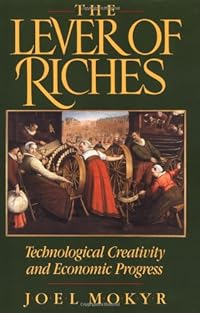
Author: Joel Mokyr
In a world of supercomputers, genetic engineering, and fiber optics, technological creativity is ever more the key to economic success. But why are some nations more creative than others, and why do some highly innovative societies--such as ancient China, or Britain in the industrial revolution--pass into stagnation?
Beginning with a fascinating, concise history of technological progress, Mokyr sets the background for his analysis by tracing the major inventions and innovations that have transformed society since ancient Greece and Rome. What emerges from this survey is often surprising: the classical world, for instance, was largely barren of new technology, the relatively backward society of medieval Europe bristled with inventions, and the period between the Reformation and the Industrial Revolution was one of slow and unspectacular progress in technology, despite the tumultuous developments associated with the Voyages of Discovery and the Scientific Revolution.
What were the causes of technological creativity? Mokyr distinguishes between the relationship of inventors and their physical environment--which determined their willingness to challenge nature--and the social environment, which determined the openness to new ideas. He discusses a long list of such factors, showing how they interact to help or hinder a nation's creativity, and then illustrates them by a number of detailed comparative studies, examining the differences between Europe and China, between classical antiquity and medieval Europe, and between Britain and the rest of Europe during the industrial revolution. He examines such aspects as the role of the state (the Chinese gave up a millenium-wide lead in shipping to the Europeans, for example, when an Emperor banned large ocean-going vessels), the impact of science, as well as religion, politics, and even nutrition. He questions the importance of such commonly-cited factors as the spill-over benefits of war, the abundance of natural resources, life expectancy, and labor costs.
Today, an ever greater number of industrial economies are competing in the global market, locked in a struggle that revolves around technological ingenuity. The Lever of Riches, with its keen analysis derived from a sweeping survey of creativity throughout history, offers telling insights into the question of how Western economies can maintain, and developing nations can unlock, their creative potential.
Author: Eliza Griswold
The tenth parallel—the line of latitude seven hundred miles north of the equator—is a geographical and ideological front line where Christianity and Islam collide. More than half of the world’s 1.3 billion Muslims live along the tenth parallel; so do sixty percent of the world’s 2 billion Christians. Here, in the buzzing megacities and swarming jungles of Africa and Asia, is where the two religions meet; their encounter is shaping the future of each faith, and of whole societies as well.
An award-winning investigative journalist and poet, Eliza Griswold has spent the past seven years traveling between the equator and the tenth parallel: in Nigeria, the Sudan, and Somalia, and in Indonesia, Malaysia, and the Philippines. The stories she tells in The Tenth Parallel show us that religious conflicts are also conflicts about land, water, oil, and other natural resources, and that local and tribal issues are often shaped by religious ideas. Above all, she makes clear that, for the people she writes about, one’s sense of God is shaped by one’s place on earth; along the tenth parallel, faith is geographic and demographic.
An urgent examination of the relationship between faith and worldly power, The Tenth Parallel is an essential work about the conflicts over religion, nationhood and natural resources that will remake the world in the years to come.
Author: Stuart Clark
The Big Questions series enables renowned experts to tackle the 20 most fundamental and frequently asked questions of a major branch of science or philosophy. Each 3000-word essay simply and concisely examines a question that has eternally perplexed enquiring minds, providing answers from history's great thinkers. This ambitious project is a unique distillation of humanity's best ideas. In Big Questions: The Universe, Dr Stuart Clark tackles the 20 key questions of astronomy and cosmology: What is the universe? How big is the universe? How old is the universe? What are stars made from? How did the Universe form? Why do the planets stay in orbit? Was Einstein right? What are black holes? How did the Earth form? What were the first celestial objects? What is dark matter? What is dark energy? Are we really made from stardust? Is there life on Mars? Are there other intelligent beings? Can we travel through time and space? Can the laws of physics change? Are there alternative universes? What will be the fate of the universe? Is there cosmological evidence for God?
Part science, part travel book. Ananthaswamy searches for cosmological truth by visiting the often remote observatories and laboratories studying the universe. Ultimately, this story is an enchanting exploration of the author's quest to understand not just a little more about the universe, but a little more about his own place within it.
2. Galileo's Daughter by Dava Sobel
The most dramatic retelling of the Galileo story for a generation, and a rather tragic tale to boot. Sobel's memorable prose relies on letters between Galileo and his oldest daughter, a nun, to shine new light on the iconic astronomer. A masterful blend of history and astronomy.
Gingerich's compelling narrative illuminates his quest to explore the cultural reception of Copernicus's revolutionary idea that the Earth orbited the sun and not vice versa. Gingerich also relates the difficulties of being an American researcher during the cold war, knowing that his quarry lay behind the iron curtain.
4. Lonely Hearts of the Cosmos by Dennis Overbye
This extended piece of top-class journalism captures astronomy as it is really practised in the corridors of academia and the lecture halls of conferences. Personal rivalries and personalities have as much to do with "progress" as having the right answer. Sprawling, complex and epic, it is also a page-turner.
5. Project Orion by George Dyson
How far will man go to reach the stars? Back in the 1950s, idealism was running high and a group of scientists and engineers gathered at The Institute for Advanced Study, Princeton, New Jersey. Their goal was to harness nuclear bombs to launch manned spacecraft. Utter madness but beautifully recounted by George Dyson, whose father was one of the misguided idealists.
6. Dragonfly by Bryan Burrough
Manned spaceflight rather than astronomy, but a vivid behind-the-scenes portrayal of America's participation in Russia's Mir space station. It strips away the PR gloss and builds a factual story that reads likes a near-future thriller. Gripping, with some genuinely jaw-dropping moments of drama.
Dense and detailed, this is a book you may have to work at, but there are rich rewards for anyone who stays the course. It also grows better with each re-reading. Koestler weaves the greatest history of astronomy up to Newton ever written.
8. Decoding the Universe by Charles Seife
Forget matter and energy, space and time, Seife argues that the most fundamental property of the universe is the information it contains. Until we accept this, we are stymied from further progress, rather like a baby playing with the box instead of the gift inside. Provocative and interesting, it challenges you to think differently.
9. The Very First Light by John C Mather and John Boslough
A thrilling tale of big science within Nasa, this is the story behind the mission that discovered the "seeds" of today's galaxies in the faint glow of the very first light left over from the creation of the universe.
10. Black Holes and Time Warps: Einstein's Outrageous Legacy by Kip S Thorne
A fantastic tale of the consequences of relativity rather than the development of it. Black holes are predicted by relativity and are the weirdest things imaginable, so weird that astronomers tried for decades to wish them away. Even today, they still don't know what they are. Cracking story, cracking science.
Story about the misuse of science to mislead the public on matters ranging from the risks of smoking to the reality of global warming. The people the authors accuse in this carefully documented book are themselves scientists—mostly physicists, former cold warriors who now serve a conservative agenda, and vested interests like the tobacco industry. The authors name these scientists—all with powerful connections in government and the media—including Robert Jastrow, Frederick Seitz, and S. Fred Singer. Seven compelling chapters detail seven issues (acid rain, the dangers of smoking and secondhand smoke, the ozone hole, global warming, the Strategic Defense Initiative, and the banning of DDT) in which this group aimed to sow seeds of public doubt on matters of settled science. They did so by casting aspersions on the science and the scientists who produce it. Oreskes, a professor of history and science studies at UC–San Diego, and science writer Conway also emphasize how journalists and Internet bloggers uncritically repeat these charges.
Author: Sonia Shah
Malaria has been a global scourge since the Ice Age, and despite the fact that it's treatable, it still kills about 1 million people a year. Scientists and physicians have worked for decades upon decades to eliminate the disease, but after tens of thousands of years, it's beginning to look unkillable. Malaria has been eradicated in the United States for nearly 60 years, but the disease has still worked its way inextricably into our cultures and identities. Many older Americans, particularly in the South, remember chasing after trucks spraying the (now banned) insecticide DDT as children, playing in the cool mist on hot summer days. Even one of the world's best-known soft drinks, tonic water, gets its name from the mixer's original use as a treatment for malaria (it contains quinine, which is still used, in larger doses, to treat the disease).
There have been deadlier, scarier and more stubborn diseases, but few that have affected human evolution and global culture as much as malaria has. In The Fever: How Malaria Has Ruled Humankind for 500,000 Years, journalist Sonia Shah provides an absorbing overview of the causes, treatments and effects of the disease, from the birth of the Plasmodium falciparum parasite in Africa thousands of years ago to global health initiatives of the past decade. In previous books, Shah has chronicled "the story of oil" (Crude) and written about pharmaceutical companies testing drugs on indigent patients (The Body Hunters). In The Fever, she displays the same curiosity, eye for history, and anger on behalf of the oppressed. (Drug companies take it squarely on the chin here as well, particularly in the chapter titled "Pharmacological Failure.")
Shah's biggest strength is her unforced, almost conversational writing style. Microbiology and epidemiology can get very complicated very quickly, but Shah proves to be an excellent translator, for the most part explaining even the most complicated scientific processes in an accessible (though never patronizing) way. At times, she gets ahead of herself — early sections on the evolution of Plasmodium required, at least for me, a rereading or two. Mostly, though, she's able to weave sections about science, history, and culture together in a seamless and fascinating way. Shah's intellectual enthusiasm and dry sense of humor recall popular science writers such as Steven Pinker and Stephen Jay Gould; her narrative strength and penchant for investigative journalism bring to mind science reporter and Flu author Gina Kolata.
"While we debate, and argue, and haphazardly collect our strength to fight malaria, the parasite refines its plague upon us," writes Shah. The Fever is a call to arms, though it's written with admirable clearheadedness and not a trace of alarmism. It's a compelling account of a disease that remains out of sight — and thus out of mind — for most Americans, even as it slowly tightens its grip on other parts of the world. Despite Shah's engaging prose and obvious enthusiasm, the subject matter means it's far from an easy read — but it might well be an essential one.
I sit down at the computer to work, but after two minutes my e-mail in-box pings. Two new messages! I read them, write quick replies, and get back to work. But then I check ESPN.com to see how the Cardinals did yesterday, and then I decide to open a Pandora station. I return to my work, but three minutes later I check on the stock market and then skim headlines on Google News. I work for another minute, and then... I’m not complaining – not entirely. I like getting information and getting it fast. But I think I’m losing something, too – concentration, focus, and patience. Do you know what I mean? In The Shallows, technology writer Nicholas Carr offers a measured but alarming answer. He concludes that the Internet is changing not only what we think about (gossip, up-to-the-minute news) but how we think. “Media ... supply the stuff of thought,” he writes, and “also shape the process of thought.” Scientists have studied this change by examining neural pathways in the brain. They have concluded, says Carr, that “virtually all of our neural circuits – whether they’re involved in feeling, seeing, hearing, moving, thinking, learning, perceiving, or remembering – are subject to change.” The Internet, along with cellphones and television, is changing our brains, these scientists conclude. Carr examines various historical advances in communication – from standardized writing to the printing press – to show how they, too, changed us. For example, literate people can better understand language, process visual signals, reason, and memorize than can illiterates. Furthermore, different languages produce different kinds of thinkers. For example, studies show English readers develop the part of the brain associated with deciphering visual shapes more than do Italians, probably because English words often look different from the way they sound, whereas Italian words are spelled just the way they are spoken. Consider how different correspondence by letter is from text messaging or e-mailing. One arrives slowly; the other is immediate. One is developed in large, sometimes complex, paragraphs; the other is often composed of single sentences. As a result, says Carr, “our indulgence in the pleasures of informality and immediacy has led to a narrowing of expressiveness and a loss of eloquence.” Also consider the difference between the book and the Web page. It requires concentration and commitment from the reader to tackle Orwell or Shakespeare. But the Internet is just the opposite, Carr notes. “When we go online, we enter an environment that promotes cursory reading, hurried and distracted thinking, and cursory learning.” Hyperlinks, for instance, provide a choice: Should I keep reading or follow the link elsewhere? This choice reroutes our thoughts, forcing us to pause for a moment to evaluate the options. Every time we encounter a hyperlink (or, for that matter, other links, advertisements, or pop-ups), our thought makes an extra turn. Not surprising, then, are the results of an experiment showing that people who read text littered with hyperlinks comprehended and remembered far less than people who read the same text without links. German researchers concluded that the average Internet user spends 10 seconds or less on a Web page. Researcher Jakob Neilson used more than 200 tiny cameras to trace human eye movement across Web pages, and found that people generally move in an “F” shape, reading across the top and then skipping down a bit to skim a bit more. When asked, “How do users read on the Web?” Neilson replied, “They don’t.” Patricia Greenfield wrote in Science magazine that the Internet has led to the “widespread and sophisticated development of visual-spatial skills,” such as rotating objects in our minds and judging distances. But with “our new spatial intelligence” comes a reduction in “deep processing” that supports “mindful knowledge acquisition, inductive analysis, critical thinking, imagination, and reflection.” Carr brilliantly brings together numerous studies and experiments to support this astounding argument: “With the exception of alphabets and number systems, the Net may well be the single most powerful mind-altering technology that has ever come into general use.” Socrates once warned that writing would “implant forgetfulness,” providing “a recipe not for memory, but for reminder.” Maybe Socrates wasn’t wrong, just ahead of his time. What would he say about the Internet?